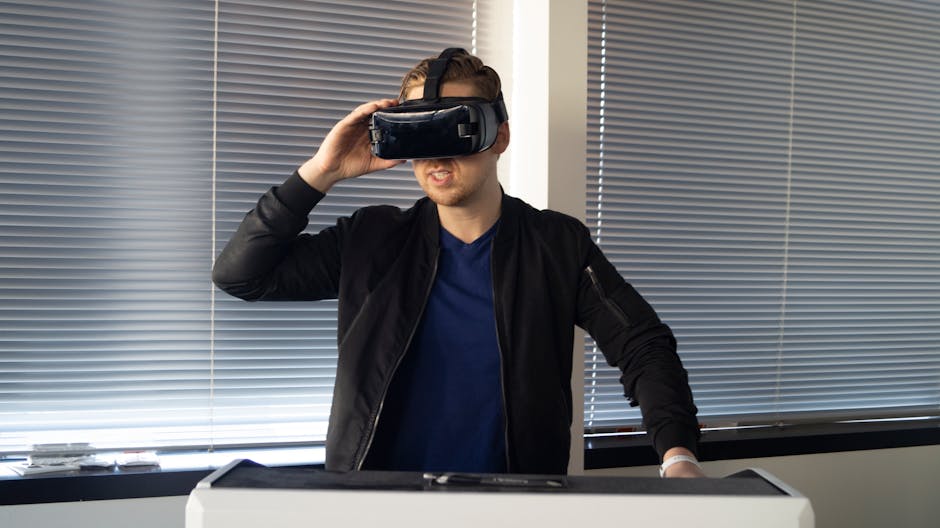
While Virtual Reality (VR) is often heralded as the ultimate tool for leadership simulation, a dangerous psychological paradox is emerging: the Expertise Trap. By creating frictionless, hyper-optimized virtual environments, leaders risk developing a false sense of mastery that dissolves the moment they face the chaotic, unpredictable variables of the physical world.
The Illusion of Infinite Iteration
The primary allure of VR lies in its ability to offer ‘infinite resets.’ In a digital twin or high-fidelity simulation, a leader can run a crisis scenario ten times until they find the optimal outcome. While this is excellent for honing technical mechanics, it fundamentally alters the brain’s relationship with risk. Real-world leadership is defined by asymmetry: you get one attempt, and the variables are rarely captured in a data set. When leaders lean too heavily on VR for strategic rehearsals, they risk atrophy in their ‘intuition under pressure’—the ability to act when the simulation ends and the unforeseen begins.
The ‘Clean Data’ Fallacy
Virtual environments thrive on high-fidelity, clean inputs. They require a closed system to function. However, the most significant strategic failures rarely stem from known variables; they emerge from ‘Unknown Unknowns’—the messy, irrational, and non-linear inputs that sensors and algorithms often strip away to maintain visual fluidity. By operating primarily within synthetic environments, executives may develop a cognitive bias that prioritizes model-based perfection over the necessary, messy reality of stakeholder management and human volatility.
Overcoming the Simulation Ceiling
To prevent VR from becoming a crutch that limits strategic foresight, leaders must adopt an ‘Anti-Fragile’ approach to their digital architecture:
Introduce Stochastic Noise: Do not just use simulations to test ‘best-case’ strategies. Integrate forced hardware failures, contradictory data feeds, and intentional communication outages into your VR environments to prevent the illusion of control.
The ‘Analog Interruption’ Protocol: After every immersive VR session, immediately force a cross-functional, low-tech debrief. This forces the brain to bridge the gap between synthetic perfection and the linguistic/social realities of your actual workforce.
Shift from Outcome to Process: Use VR to map team behaviors during the decision-making process, rather than focusing on the ‘winning’ outcome of the simulation. A successful outcome in a controlled digital space is often a vanity metric; the true value lies in identifying where your team’s psychological biases trigger under load.
Leading Beyond the HMD
The danger is not the technology itself, but the comfort it provides. As we integrate more AI-driven synthetic environments into our daily management, we must remain vigilant. A leader who spends too much time in a perfected, virtual version of their company may find themselves fundamentally unequipped for the boardroom, where the stakes are real and there is no ‘Reset’ button. Use VR to expand your capability, but never let it replace the grit required to navigate the ambiguity of the real world.
For further insights into high-performance methodologies and how to balance digital-first strategies with human-centric leadership, visit The BossMind Platform.