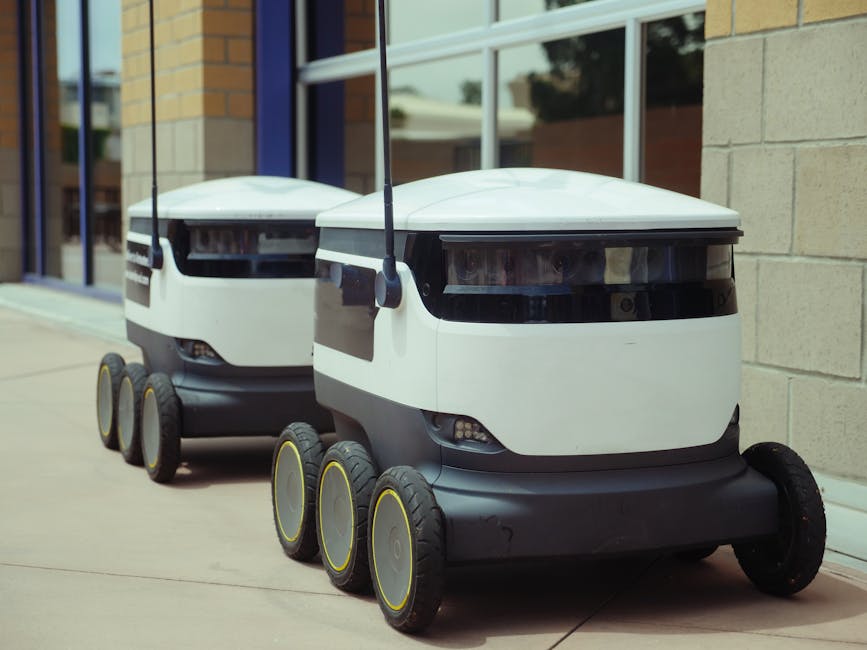
1. Introduction: Defining Zero-Shot Autonomous Logistics and its intersection with Cognitive Science.
2. Key Concepts: Neural priors, latent space representation, and the “Cognitive Gap” in robotics.
3. Step-by-Step Guide: Implementing a Zero-Shot Policy framework for logistics.
4. Case Studies: Real-world applications in warehouse automation and supply chain resilience.
5. Common Mistakes: Over-reliance on simulation, data drift, and neglecting environmental context.
6. Advanced Tips: Neuro-symbolic integration and predictive uncertainty modeling.
7. Conclusion: The future of autonomous decision-making.
***
Zero-Shot Autonomous Logistics: Bridging Cognitive Science and Robotic Control
Introduction
The traditional paradigm of autonomous logistics relies heavily on intensive training cycles. To teach a robot to navigate a warehouse or manage inventory, engineers typically feed the system thousands of hours of simulated or real-world data. However, the modern supply chain is defined by volatility, where “unknown unknowns”—such as sudden infrastructure shifts or unprecedented inventory layouts—are the norm, not the exception. Enter Zero-Shot Autonomous Logistics.
By leveraging principles from cognitive science, specifically the human capacity for generalization, we are moving toward agents that can make optimal decisions in environments they have never seen before. This isn’t just about efficiency; it is about creating resilient systems that mimic the cognitive flexibility of the human brain. This article explores how to architect these policies to ensure your logistics operations remain agile in an unpredictable world.
Key Concepts
To understand Zero-Shot logistics, we must look at how the brain processes novel environments. Humans do not need to “re-train” when they enter a new room; they use neural priors—pre-existing conceptual frameworks—to interpret the space. In robotics, this is achieved through three primary pillars:
Latent Space Representation: Instead of processing raw pixels, the agent maps environmental inputs into a compressed, meaningful mathematical space. This allows the system to recognize the “essence” of a task (e.g., “stacking a box”) regardless of the box’s color, size, or location.
Zero-Shot Generalization: This is the ability to apply a learned policy to a task or environment without any fine-tuning. It relies on the model’s ability to identify structural similarities between known and novel environments.
Cognitive Architecture: By incorporating symbolic reasoning alongside neural networks, we provide the robot with “common sense” rules that constrain its behavior, preventing the reckless actions often produced by pure deep learning.
Step-by-Step Guide
Implementing a Zero-Shot policy requires shifting your focus from data quantity to model architecture. Follow these steps to transition your logistics framework:
Define the Task Ontology: Break down your logistics operations into atomic tasks—lifting, sorting, navigating, and identifying. Ensure these definitions are semantic rather than spatial.
Train on Diverse Synthetic Distributions: Use domain randomization. Generate thousands of variations of your warehouse in a simulator, altering lighting, textures, and physical layouts. The goal is to make the model “bored” of specific environments so it learns to rely on structural logic instead.
Implement a Vision-Language Backbone: Utilize pre-trained models (like CLIP-based architectures) that understand human language. This allows you to give the robot a command like “move the fragile items to the high-shelf,” and the agent interprets the semantic meaning of “fragile” and “high-shelf” without needing a pre-mapped coordinate for every item.
Deploy with an Uncertainty Threshold: Build a “safety layer” that monitors the agent’s confidence. If the robot encounters a scenario where its predictive uncertainty exceeds a set limit, it should default to a “human-in-the-loop” mode rather than attempting a high-risk maneuver.
Examples and Case Studies
Consider a large-scale e-commerce distribution center experiencing a surge in non-standard, oddly shaped returns. A traditional, supervised-learning robot would fail because it hasn’t seen these specific shapes in its training set. A Zero-Shot autonomous agent, however, recognizes the structural properties of the objects—weight distribution, surface friction, and center of gravity—based on its prior training. It treats the new object as a “variation of a liftable load” rather than an “unknown error.”
Another real-world application involves cross-docking operations where floor plans change daily. By utilizing zero-shot policies, mobile robots can navigate a facility that was rearranged overnight. They don’t need a new map; they use their semantic understanding of “aisle,” “pathway,” and “obstacle” to interpret the new layout instantly.
Common Mistakes
The Simulation-to-Reality Gap: Many teams over-fit their models to high-fidelity simulators that don’t account for real-world physics, such as sensor noise or lighting glare. Always prioritize “noisy” synthetic data over “perfect” data.
Ignoring Contextual Drift: Logistics environments are dynamic. If your model doesn’t account for temporal shifts (like the speed of human movement in the warehouse), it will eventually fail. Your policy must be context-aware, not just object-aware.
Data Siloing: Zero-shot learning thrives on diversity. If your model is trained only on data from one specific warehouse, it will fail to generalize. Cross-pollinate your training sets with data from different logistics hubs.
Advanced Tips
To push your autonomous logistics to the next level, look into Neuro-symbolic AI. While deep learning is excellent at pattern recognition, it struggles with logic. By embedding logic-based rules (e.g., “never place heavy items on top of light ones”) into your neural network, you create a system that is both intuitive and inherently compliant with safety regulations.
Additionally, incorporate Predictive Uncertainty Modeling. Most autonomous systems provide a single “best guess” for an action. Advanced models should provide a confidence interval. If the robot is only 60% sure it can pick up a heavy box, the policy should trigger a “cautious approach” state, reducing speed and increasing sensor frequency. This mimics the human cognitive process of slowing down when walking through a dark or unfamiliar space.
Conclusion
Zero-Shot autonomous logistics represents a fundamental shift from “teaching robots what to do” to “teaching robots how to learn.” By leveraging cognitive science principles—generalization, semantic understanding, and uncertainty management—you can build logistics systems that are not just automated, but truly autonomous.
The goal of autonomous logistics is not to create a system that knows everything, but to create a system that can handle anything. Focus on building robust, semantic-based priors, and your operations will become significantly more resilient to the disruptions of the modern supply chain.
As you begin to integrate these policies, remember that the objective is to reduce the cognitive load on your human operators while increasing the adaptive capacity of your machines. The future of logistics lies in this synergy between human-like reasoning and robotic execution.