Real-World Applications: Autonomous navigation and predictive maintenance.
Common Mistakes: Overfitting, ignoring sensor noise, and computational bottlenecks.
Advanced Tips: Active learning and Gaussian Processes for real-time recalibration.
Conclusion: The future of reliable human-robot collaboration.
Bridging the Gap: Uncertainty-Quantified Digital Twins in Robotics
Introduction
For years, the “Digital Twin” has been marketed as a perfect, real-time mirror of a physical asset. In the world of industrial robotics, however, a digital twin that assumes perfection is a liability. Traditional models are deterministic; they provide a single output based on a set of inputs. But the real world is messy, stochastic, and fraught with sensor noise and mechanical wear.
The next frontier in robotics is the Uncertainty-Quantified (UQ) Digital Twin. By integrating probabilistic models into the simulation-to-reality pipeline, engineers can move beyond asking “What will the robot do?” to asking “How confident is the robot in its next move?” This shift is not merely academic—it is the prerequisite for moving robots out of caged industrial cells and into unpredictable, human-centric environments.
Key Concepts
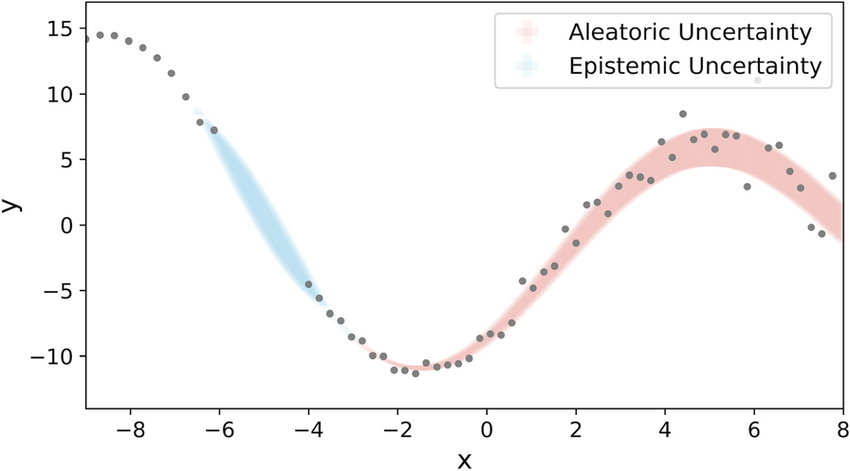
To understand UQ digital twins, we must differentiate between two types of uncertainty that plague robotic systems:
Aleatoric Uncertainty: This represents the inherent randomness in the environment or sensor data. Think of it as “noise”—unpredictable fluctuations in lighting, friction, or communication latency that cannot be eliminated, only modeled.
Epistemic Uncertainty: This is “model uncertainty.” It arises from a lack of knowledge or data. If a robot encounters an object it has never seen before, its model is uncertain because it hasn’t learned the representation of that object yet. This is the uncertainty we aim to reduce through better training and data acquisition.
A UQ Digital Twin functions as a Bayesian framework where every state prediction is accompanied by a probability distribution. Instead of the digital twin predicting a robot arm will reach coordinates (x, y, z), it predicts a 95% confidence interval around those coordinates. This provides the robot’s controller with a “safety budget,” allowing it to slow down or request human intervention when the uncertainty threshold exceeds safe limits.
Step-by-Step Guide: Implementing UQ in Robotic Twins
Probabilistic Modeling: Replace deterministic neural networks or physics engines with probabilistic alternatives. Utilize Bayesian Neural Networks (BNNs) or Gaussian Processes (GPs) to capture the distribution of possible outcomes rather than a point estimate.
Stochastic Simulation: Run your digital twin through Monte Carlo simulations. Instead of one simulation run, execute thousands, varying initial conditions (e.g., joint friction, payload mass) based on observed historical variances.
Sensor Fusion and Filtering: Implement Extended Kalman Filters (EKF) or Particle Filters within the twin to integrate real-time telemetry. This ensures the digital twin is constantly recalibrated against the physical robot’s actual performance.
Threshold Setting: Define “Critical Uncertainty Zones.” If the model’s prediction variance exceeds a specific limit, trigger a “Safe Mode” protocol in the physical hardware.
Feedback Loop Integration: Use the residual error between the digital prediction and physical reality to update the twin’s parameters dynamically. If the robot performs differently than expected, the twin should “learn” that its underlying model needs adjustment.
Real-World Applications
Autonomous Warehouse Navigation: Mobile robots often struggle with dynamic obstacles like humans or misplaced pallets. A UQ digital twin allows a robot to navigate a crowded aisle by “seeing” the potential paths of humans as probability clouds. If the uncertainty of a human’s trajectory is too high, the robot proactively pauses, preventing collisions before they become likely.
Predictive Maintenance for Precision Actuators: By monitoring the torque variance in a robotic joint, the digital twin can quantify the uncertainty in mechanical wear. When the “uncertainty” in the joint’s behavior grows beyond a historical baseline, the system generates a maintenance ticket. This prevents catastrophic failure by flagging the component while it is still functional but statistically deviating from its “healthy” digital model.
Common Mistakes
Ignoring Latency: A digital twin is useless if it is not synchronized. If the uncertainty calculation takes longer than the robot’s decision cycle, the digital twin is essentially predicting the past.
Over-Smoothing: In an attempt to make the model “clean,” engineers often filter out the noise that actually contains the most valuable information. Ensure your UQ model accounts for the raw sensor variance.
Static Modeling: Treating the digital twin as a fixed piece of software. A UQ twin must be a living entity that evolves as the physical robot ages and the environment changes.
The “Black Box” Trap: Using complex deep learning models without explainability. If the system reports high uncertainty, the engineer must be able to trace it back to which sensor or sub-system is failing.
Advanced Tips
To take your digital twin to the next level, consider Active Learning. Configure the robot to intentionally seek out information when its epistemic uncertainty is high. For example, if a robotic bin-picking system is unsure about the orientation of a part, the digital twin can command the robot to rotate the object to a position that minimizes the model’s uncertainty.
Furthermore, utilize Gaussian Processes (GP) for local modeling of complex dynamics. GPs are excellent at providing non-parametric uncertainty estimates. By deploying a GP to model the residual error of your primary physics engine, you can create a “hybrid twin” that combines the speed of traditional physics with the robust uncertainty quantification of machine learning.
Conclusion
The transition from deterministic models to uncertainty-quantified digital twins is the bridge between robots that work only in controlled labs and robots that can reliably function in the wild. By treating uncertainty not as a failure of the model, but as a critical data point, we empower robots to be more cautious, more adaptive, and ultimately, more capable.
As we move toward a future of increased human-robot collaboration, the ability of a machine to “know what it doesn’t know” will be its most valuable asset. Start by auditing your current robotic telemetry, identifying where deterministic assumptions are failing, and layering probabilistic frameworks into your simulation environments. The result will be a digital twin that doesn’t just mirror the past, but anticipates the complexities of the future.



Leave a Reply