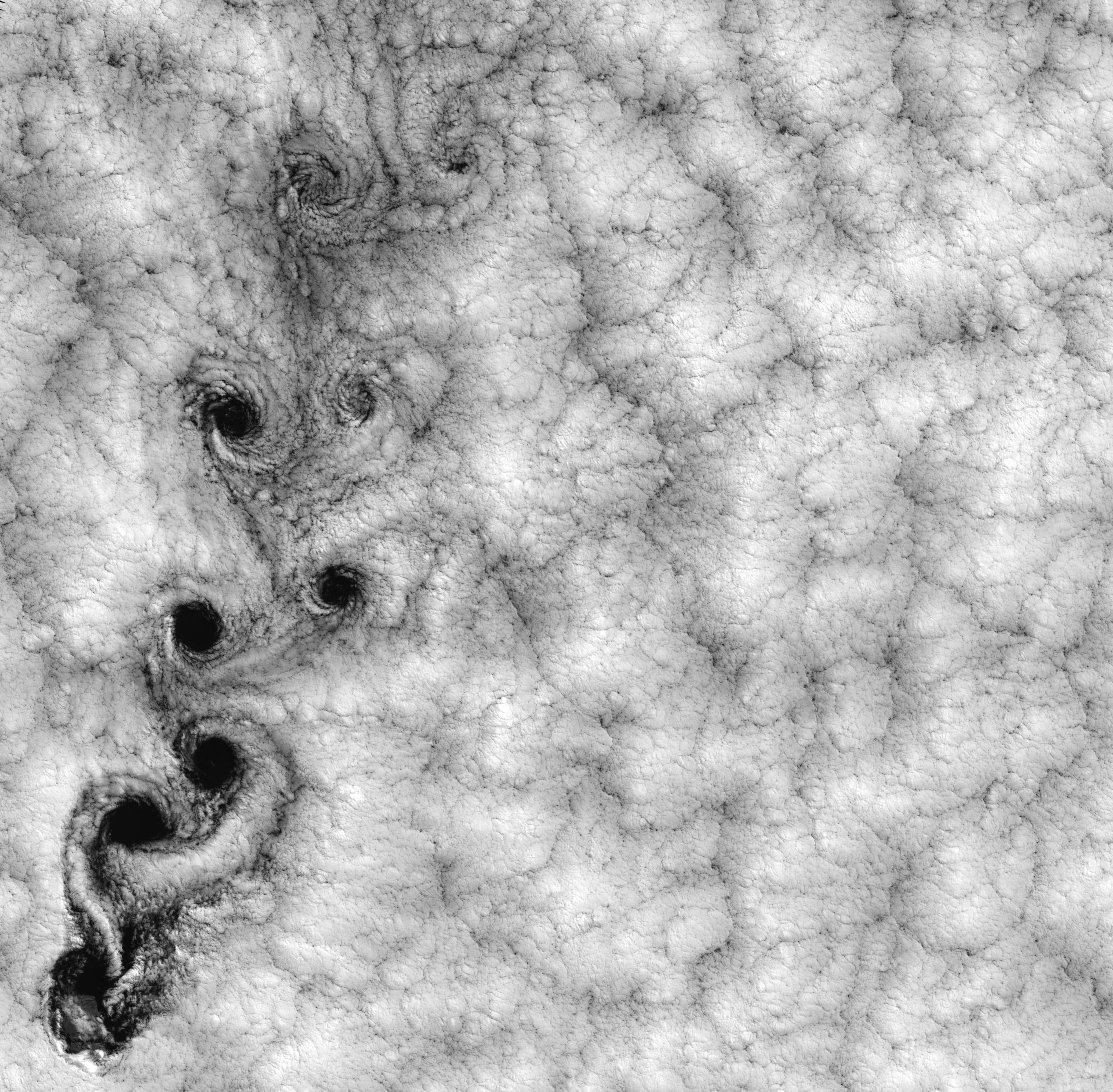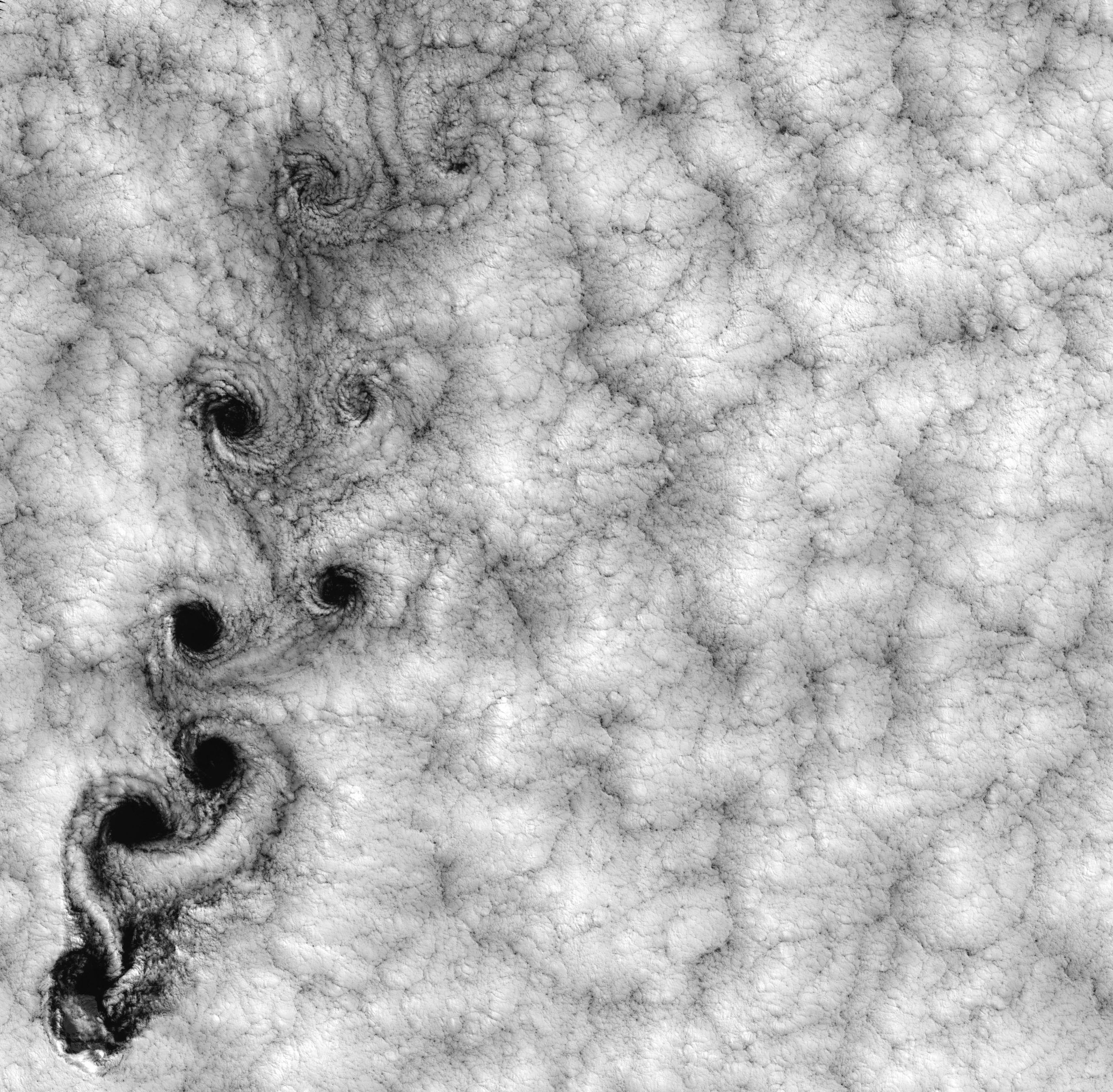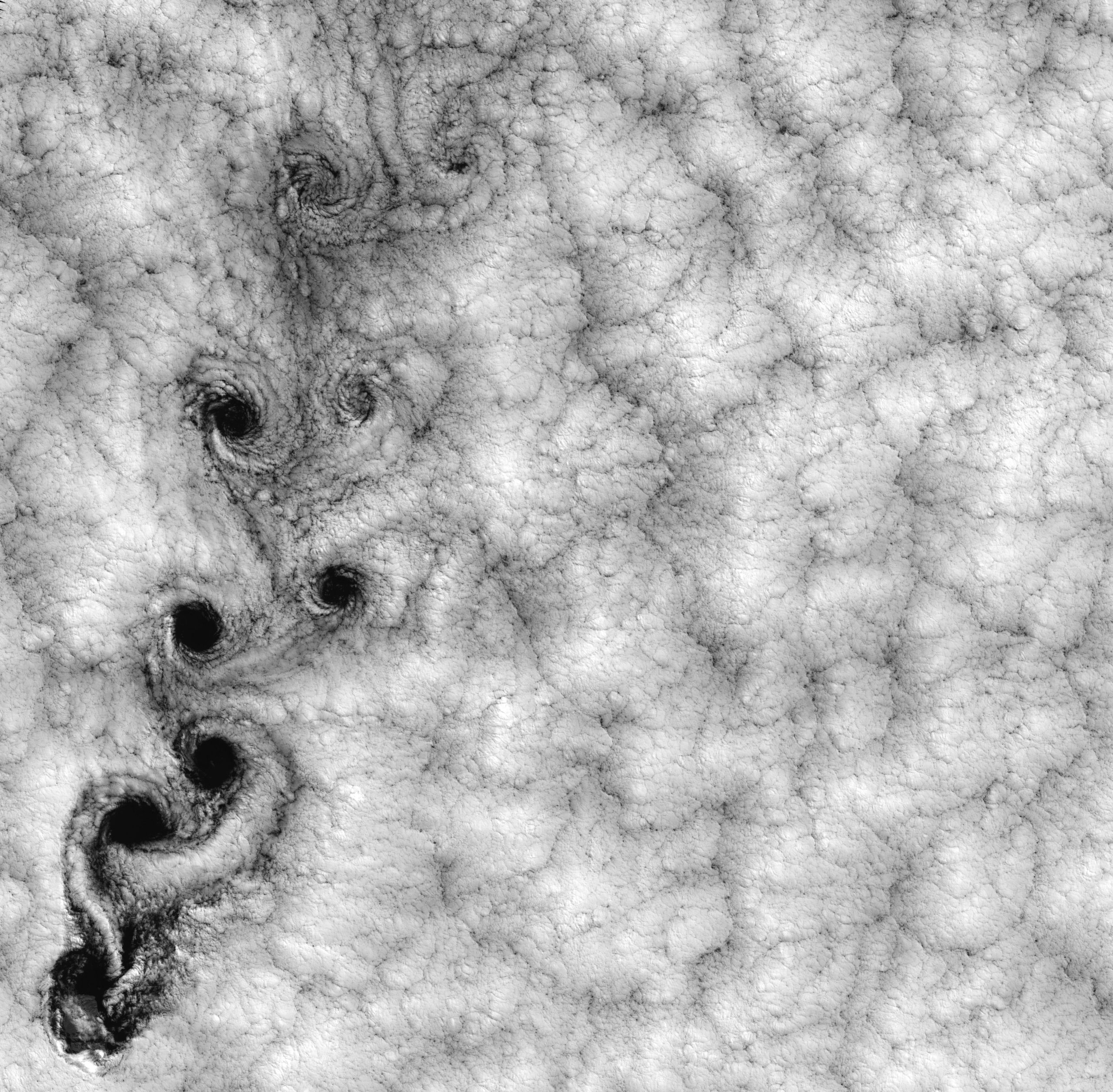
NASA image acquired September 15, 1999 This Landsat 7 image of clouds off the Chilean coast near the Juan Fernandez Islands (also known as the Robinson Crusoe Islands) on September 15, 1999, shows a unique pattern called a “von Karman vortex street.” This pattern has long been studied in the laboratory, where the vortices are created by oil flowing past a cylindrical obstacle, making a string of vortices only several tens of centimeters long. Study of this classic “flow past a circular cylinder” has been very important in the understanding of laminar and turbulent fluid flow that controls a wide variety of phenomena, from the lift under an aircraft wing to Earth’s weather. Here, the cylinder is replaced by Alejandro Selkirk Island (named after the true “Robinson Crusoe,” who was stranded here for many months in the early 1700s). The island is about 1.5 km in diameter, and rises 1.6 km into a layer of marine stratocumulus clouds. This type of cloud is important for its strong cooling of the Earth’s surface, partially counteracting the Greenhouse warming. An extended, steady equatorward wind creates vortices with clockwise flow off the eastern edge and counterclockwise flow off the western edge of the island. The vortices grow as they advect hundreds of kilometers downwind, making a street 10,000 times longer than those made in the laboratory. Observing the same phenomenon extended over such a wide range of sizes dramatizes the “fractal” nature of atmospheric convection and clouds. Fractals are characteristic of fluid flow and other dynamic systems that exhibit “chaotic” motions. Both clockwise and counter-clockwise vortices are generated by flow around the island. As the flow separates from the island’s leeward (away from the source of the wind) side, the vortices “swallow” some of the clear air over the island. (Much of the island air is cloudless due to a local “land breeze” circulation set up by the larger heat capacity of the waters surrounding the island.) The “swallowed” gulps of clear island air get carried along within the vortices, but these are soon mixed into the surrounding clouds. Landsat is unique in its ability to image both the small-scale eddies that mix clear and cloudy air, down to the 30 meter pixel size of Landsat, but also having a wide enough field-of-view, 180 km, to reveal the connection of the turbulence to large-scale flows such as the subtropical oceanic gyres. Landsat 7, with its new onboard digital recorder, has extended this capability away from the few Landsat ground stations to remote areas such as Alejandro Island, and thus is gradually providing a global dynamic picture of evolving human-scale phenomena. For more details on von Karman vortices, refer to http://climate.gsfc.nasa.gov/~cahalan. Image and caption courtesy Bob Cahalan, NASA GSFC Instrument: Landsat 7 - ETM+ Credit: NASA/GSFC/Landsat <b><a href="http://www.nasa.gov/centers/goddard/home/index.html" rel="nofollow">NASA Goddard Space Flight Center</a></b> enables NASA’s mission through four scientific endeavors: Earth Science, Heliophysics, Solar System Exploration, and Astrophysics. Goddard plays a leading role in NASA’s accomplishments by contributing compelling scientific knowledge to advance the Agency’s mission. <b>Follow us on <a href="http://twitter.com/NASA_GoddardPix" rel="nofollow">Twitter</a></b> <b>Join us on <a href="http://www.facebook.com/pages/Greenbelt-MD/NASA-Goddard/395013845897?ref=tsd" rel="nofollow">Facebook</a></b>
The Infinite Geometry: How Fractal Patterns Reveal the Blueprint of Reality
Introduction
When you look closely at the branching of a river system, the intricate lace of a fern leaf, or the jagged silhouette of a mountain range, you are witnessing more than mere chance. You are observing the fundamental architecture of the physical universe. These phenomena are governed by fractals—geometric shapes that repeat their structure at every scale. Understanding these patterns is not merely an exercise in mathematics; it is a way to decode the hidden structural language of reality itself.
For centuries, Euclidean geometry—based on smooth lines and perfect circles—failed to describe the rough, irregular nature of the world. Fractal geometry, popularized by Benoit Mandelbrot, provides the missing link. By studying how nature utilizes self-similarity to maximize efficiency and surface area, we can gain practical insights into everything from organizational management to personal resilience.
Key Concepts
At its core, a fractal is a “never-ending pattern.” The most essential characteristic is self-similarity. This means that a small part of the structure, when magnified, looks like the whole structure. Think of a head of Romanesco broccoli: every small floret is a miniature version of the entire vegetable.
In nature, this isn’t just aesthetic; it is functional. Fractals allow systems to pack maximum surface area into a minimum volume. Consider the human lung. The bronchial tree branches repeatedly, creating a massive surface area for gas exchange within the small, compact confines of your chest cavity. Without this fractal branching, the human respiratory system could not support our metabolic needs.
Fractals also exist on a spectrum of dimensional complexity. While a line is one-dimensional and a square is two-dimensional, a fractal occupies a “fractional” dimension. This explains why a coastline is longer than the straight line connecting its two ends; the closer you look, the more detail you find, and the longer the measurement becomes. This is the “Fractal Dimension,” a numerical representation of how well a pattern fills space.
Step-by-Step Guide: How to Apply Fractal Thinking
You can apply the principles of fractal geometry to your life, business, and creative projects to increase efficiency and order. Follow these steps to harness the power of self-similarity.
- Identify the “Seed” Structure: Every successful project has a core set of values or processes. Identify the “seed”—the simplest version of your goal. For a business, this might be the core interaction between one employee and one customer.
- Emulate the Pattern: Once your core interaction is optimized, replicate it exactly at the next level of magnitude. If your one-on-one customer service is excellent, ensure that the team-to-team communication mirrors that same level of quality and feedback.
- Iterate Across Scales: Fractals are not static; they grow through iteration. Review your system at different “scales.” Ask yourself: Is the culture of my daily workflow consistent with the long-term vision of my five-year plan? If the small-scale behavior contradicts the large-scale goal, the system will eventually fracture.
- Optimize for Efficiency: Fractals are nature’s way of reducing “travel time” for energy. In your workflows, look for bottlenecks where information or resources have to travel too far without “branching.” Decentralize your processes to mirror the efficiency of a circulatory system.
Examples and Case Studies
Architecture and Urban Planning: Biophilic architecture increasingly utilizes fractal patterns in design. Studies have shown that viewing fractal patterns reduces stress levels in humans by up to 60%. Architects like Frank Lloyd Wright utilized these geometries to make buildings feel as though they were “grown” from the landscape rather than placed upon it, creating spaces that feel inherently comfortable.
Technology and Antenna Design: Modern smartphones rely on “fractal antennas.” By folding a wire into a fractal pattern, engineers can fit a long antenna into a tiny space. This allows a device to receive multiple frequencies simultaneously, which is why your phone can connect to Wi-Fi, Bluetooth, and cellular networks using a single, compact internal component.
Market Analysis: Financial analysts often apply fractal geometry to market data. Prices in the stock market do not follow a “random walk”; they exhibit fractal characteristics where patterns in short-term trading mirror patterns in long-term market cycles. Understanding these self-similar fluctuations helps professional traders better manage risk during periods of high volatility.
Common Mistakes
- Confusing Complexity with Fractal Structure: Just because something is chaotic or messy does not mean it is a fractal. True fractals possess mathematical order. Mistaking raw noise for a structured fractal can lead to poor decision-making based on false patterns.
- Ignoring Scale Limits: Natural fractals are physically limited. A tree cannot branch infinitely because of the structural integrity of its cells. In business, do not attempt to scale a process indefinitely without accounting for the “breaking point” where the pattern can no longer support itself.
- Rigid Standardization: Attempting to force a “one-size-fits-all” solution is the opposite of fractal thinking. Fractals are self-similar, not identical. Allow your processes to adapt slightly to the local environment (e.g., individual team needs) while maintaining the core structural “DNA.”
Advanced Tips
To truly master the fractal nature of reality, you must embrace the concept of Feedback Loops. Fractals are generated by repeating a mathematical equation, where the output of one iteration becomes the input for the next. In your own life, look for your personal feedback loops.
The quality of your output today is a direct function of the quality of your input yesterday. If you want to change the “large-scale” structure of your life, you do not need to change the whole system at once. You only need to alter the “seed” formula of your daily habits.
Furthermore, look into Fractal Aesthetics. By incorporating these patterns into your visual environment—through interior design, art, or even the layout of your digital workspace—you can tap into the subconscious biological preference for these geometries. This has been shown to improve cognitive focus and decrease neural fatigue, essentially “tuning” your environment to the frequency of natural efficiency.
Conclusion
The connection between fractal patterns in nature and the structure of reality is not a coincidence; it is a testament to the efficiency of the universe. By repeating simple, elegant structures, nature achieves immense complexity and resilience. We are, in effect, walking through a world built on the principles of recursive iteration.
By shifting your mindset to recognize these patterns, you can move away from trying to control outcomes through force and toward building systems that replicate their own success. Whether you are scaling a business, designing a product, or structuring your personal growth, the answer often lies in the “seed” of the pattern. Understand the fractal, and you gain the power to design with the same efficiency that governs the growth of the stars, the trees, and the very flow of your own life.