Beyond the Flat Screen: The Strategic Imperative of Stereoscopic Display in Enterprise
For the last four decades, the digital revolution has been fundamentally constrained by a two-dimensional bottleneck. Whether you are a venture capitalist analyzing portfolio performance, an engineer designing complex mechanical assemblies, or a surgeon performing remote consultations, you have been forced to map three-dimensional reality onto a flat, 2D plane. This translation—from spatial cognition to planar representation—is the single largest point of friction in modern cognitive labor.
The emergence of high-fidelity stereoscopic display technology is not merely a gadget upgrade; it is a fundamental shift in the human-computer interface (HCI). As we move into an era defined by spatial computing and high-stakes digital modeling, stereoscopy is transitioning from a niche laboratory curiosity into a mission-critical tool for competitive advantage.
The Problem: The “Cognitive Tax” of Planar Interfaces
The human brain is evolutionarily hardwired for spatial awareness. We process depth, volume, and parallax natively. Yet, our workflows—Excel models, CAD renderings, remote collaboration—force us to “flatten” our environment. This causes what experts call Cognitive Tax: the extra mental effort required to mentally reconstruct a 3D object from 2D projections.
In high-stakes industries, this tax results in:
Latency in Iteration: Designers and engineers lose valuable hours verifying spatial relationships that a stereoscopic view could confirm in milliseconds.
Decision Fatigue: The brain burns more glucose and oxygen interpreting flattened complex data sets compared to natural depth perception.
Precision Errors: In fields like precision manufacturing or medical diagnostics, the inability to perceive true depth leads to costly, preventable mistakes.
If your organization is still relying solely on 2D screens for complex problem-solving, you are effectively working with one eye closed. The competition is already beginning to open both.
The Mechanics: How Stereoscopy Transforms Data Consumption
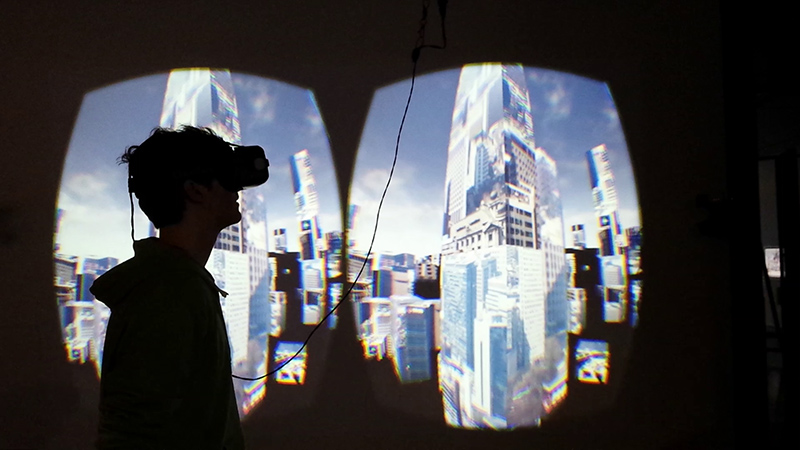
Stereoscopic display works by delivering slightly different images to the left and right eyes, mimicking the way our eyes receive light in the physical world (binocular disparity). When the brain fuses these images, it perceives depth. However, professional-grade stereoscopy goes beyond mere “3D effects.”
The Three Pillars of Spatial Computing
Binocular Disparity: The foundation of depth perception. By calculating the shift in perspective, we create an immersive workspace where objects occupy distinct spatial coordinates.
Motion Parallax: As the user moves their head, the display updates in real-time. This dynamic feedback loop provides a profound sense of “object permanence” for digital assets.
Convergence-Accommodation Matching: The “holy grail” of current display tech. Modern light-field and high-refresh stereoscopic displays are finally solving the vergence-accommodation conflict—the primary cause of eye strain and simulator sickness—making professional-grade use sustainable for 8-hour workdays.
Expert Insights: Why “VR” is not the Standard for Enterprise
There is a dangerous misconception that virtual reality (VR) headsets are the only path to stereoscopy. For the enterprise, this is often a strategic error. VR isolates the user, creates “siloed workflows,” and interrupts natural office communication.
The Pro-Level Strategy: Look toward Autostereoscopic (glasses-free) displays and light-field monitors. These technologies allow for:
Collaborative Visualization: Multiple stakeholders can view the same model from different angles simultaneously without cumbersome hardware.
Ergonomic Integration: These displays sit on your existing desk, maintaining your current workflow while adding a spatial dimension.
High-Fidelity Interaction: By integrating these displays with haptic input or spatial controllers, you bridge the gap between “looking at” and “working on.”
The Implementation Framework: A Three-Phase Adoption Model
Do not attempt a total overhaul overnight. Use this framework to integrate stereoscopic workflows strategically:
Phase 1: The High-Value Diagnostic (Audit)
Identify the “bottleneck tasks” in your organization. Ask: Where does 2D representation limit our decision-making? This is usually found in R&D, product design, complex financial modeling, or high-end architectural visualization.
Phase 2: The Pilot Integration
Equip a high-performing “Tiger Team” with light-field or stereoscopic displays. Do not replace their primary workstations. Instead, deploy the stereoscopic display as a secondary, context-specific monitor exclusively for 3D modeling and spatial data analysis. Measure the time-to-first-prototype reduction.
Phase 3: The Workflow Architecture
Standardize the data pipeline. Ensure that your CAD software, digital twin platforms, and data analytics tools are outputting data compatible with spatial displays. The hardware is useless without a workflow that treats 3D data as a primary asset class.
Common Pitfalls: What Most Organizations Get Wrong
1. Over-Indexing on Gimmicks: Many businesses purchase “3D monitors” that are essentially consumer-grade gimmicks. They lack the resolution, depth-mapping, and refresh rates required for professional engineering. Buy hardware that supports industry-standard plugins (Unity, Unreal Engine, SolidWorks).
2. Ignoring Ergonomics: If your display solution requires 30 minutes of setup or induces headaches, it will never be used. The technology must be frictionless to be adopted.
3. Siloing the Technology: If only the IT department understands the display, the organization will fail to derive value. You must educate your project managers and leads on why they are viewing the data in 3D, or they will revert to the “comfortable” 2D view.
The Future: Toward the Spatial Internet
We are rapidly approaching a threshold where stereoscopic capabilities will be standard in high-end workstations. As AI continues to automate routine tasks, human capital will be redirected toward high-level synthesis and creative problem-solving. This requires a deeper level of cognitive immersion.
Watch for the convergence of AI-driven real-time rendering and light-field displays. Soon, you will not just be looking at a stereoscopic image; you will be interacting with a “digital twin” of your business operations in real-time, pulling layers of data through space as if they were physical objects on your desk.
Conclusion: The Competitive Edge
Stereoscopic display is no longer a peripheral luxury; it is the infrastructure for the next generation of industrial and creative intelligence. By moving your workflow into the spatial domain, you unlock faster iteration cycles, deeper intuitive understanding of complex systems, and a decisive advantage in precision-driven industries.
The transition from 2D to 3D displays is the new “moving from paper to spreadsheet” moment. The question is not whether your industry will adopt it—the question is whether you will be an early adopter setting the new standard, or an incumbent catching up when the shift becomes inevitable.
Strategic Next Step: Conduct a 30-day “Depth Impact Audit.” Select a single project currently constrained by 2D bottlenecks and pilot a professional stereoscopic workspace. The results in cognitive throughput will be your business case for broader, enterprise-wide deployment.