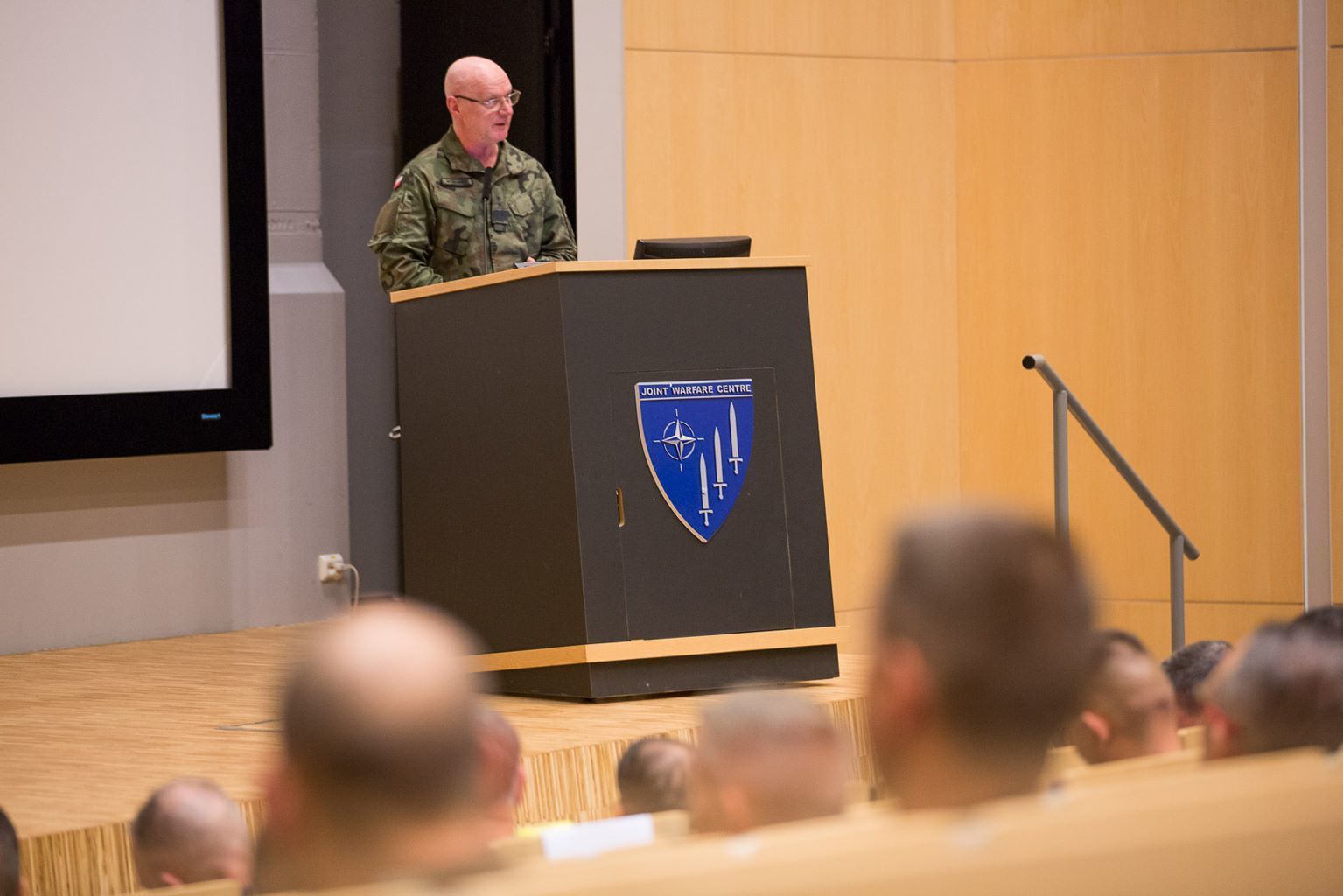
National and NATO senior amphibious and maritime leaders are conducting a command and control (C2) wargame at NATO’s Joint Warfare Centre (JWC) in Stavanger, Norway.
Under the auspice of the Amphibious Leaders Expeditionary Symposium (ALES), the scenario-based tabletop wargame aims at improving the C2 effectiveness and efficiency of multinational maritime and amphibious forces in support of NATO.
The wargame is facilitated by U.S. Marine Corps Major General Russell A. C. Sanborn, the Commander of U.S. Marine Corps Forces, Europe and Africa (MARFOREUR/AF), the leading command behind the ALES initiative.
The wargame in Stavanger is the fourth iteration of ALES, which started two years ago in Stuttgart, Germany, home to MARFOREUR/AF Headquarters, as a forum for senior amphibious leaders to discuss key aspects of multinational amphibious operations.
The previous iterations of ALES took place in Italy (NATO Joint Force Command Naples) and the United Kingdom (Allied Maritime Command Northwood), respectively. Topics discussed primarily included: amphibious interoperability, collective defence and vast Major Joint Operations concept, NATO readiness, and the amphibious task force-level C2 during large-scale amphibious operations.
The goal was to set the chart for the future amphibious operations, with a focus on ever-increasing conventional maritime threats facing the NATO Alliance.
“It is a great pleasure to host the amphibious wargame at the Joint Warfare Centre,” said Polish Army Major General Andrzej Reudowicz, Commander JWC, during his opening remarks. “NATO has increased its focus on the maritime domain. With this event, we also welcome Rear Admiral John Skillman, JWC’s former Deputy Commander, who is participating the wargame in his current position as Commander of the Expeditionary Strike Group 2.”
Major General Reudowicz then explained that the Joint Warfare Centre was established to deliver and continuously improve training for
Outline
Introduction: The convergence of AI and storytelling as the new folklore engine.
Key Concepts: Defining synthetic media, generative narrative, and the “digital mythos.”
Step-by-Step Guide: How to construct a modern myth using synthetic tools.
Examples/Case Studies: Analyzing the “Backrooms” phenomenon and AI-generated “found footage.”
Common Mistakes: Pitfalls in authenticity, ethical boundaries, and narrative coherence.
Advanced Tips: Utilizing iterative feedback loops for world-building.
Conclusion: The future of collaborative digital legends.
The Digital Hearth: Crafting Modern Mythology with Synthetic Media
Introduction
For millennia, myths were the adhesive of human society—narratives that explained the inexplicable, codified moral landscapes, and turned isolated tribes into unified cultures. Today, the campfire has been replaced by the feed, and the oral tradition has evolved into the algorithmic stream. We are entering an era where synthetic media—AI-generated imagery, deep-audio, and predictive text—is not merely a tool for marketing, but the new forge for modern mythology.
The creation of a modern myth is no longer restricted to literary giants or cinematic auteurs. With synthetic media, individuals can manifest immersive, consistent, and hauntingly realistic narratives that spread virally, bypassing traditional gatekeepers. This shift matters because it changes how we define “truth” in the digital age. As synthetic media blurs the line between historical record and creative art, we are witnessing the birth of “Algorithmic Folklore”—myths born of code that feel more tactile than history itself.
Key Concepts
To understand the role of synthetic media in myth-making, we must define the core pillars:
Synthetic Media: Content generated or modified by AI. This includes Midjourney for visuals, ElevenLabs for voice synthesis, and GPT-4 for iterative world-building.
Hyper-Reality: A concept where the simulation of something becomes more real than the reality it imitates. In a mythological context, this is when an AI-generated character or urban legend gains enough traction to influence real-world behavior or belief.
Participatory Lore: Unlike classical myths, which were passed down vertically, modern synthetic myths are horizontal. The audience participates in the canon-building, using AI to generate “expansions” or “fan-mythos,” creating a recursive loop of content.
Mythology has always been about authority. Whoever controls the narrative controls the archetype. Synthetic media democratizes this control, allowing for the rapid deployment of “liminal entities”—figures like Slenderman or the Backrooms—which occupy the space between the known and the unknown.
Step-by-Step Guide: Building a Digital Mythos
Creating a contemporary myth requires a blend of narrative design and technical deployment. Follow this framework to structure your digital legend:
Establish the “Liminal Anchor”: Identify a mundane setting or object that can be made uncanny. A myth needs a place to live—an empty office, a forgotten website, or a recurring dream. Use AI image generation to create “found footage” that anchors the myth in a pseudo-realistic aesthetic.
Develop the “Unreliable Oracle”: Myths require a voice. Use synthetic audio to create a persona that sounds like a whistle-blower, a cryptic historian, or an AI gone rogue. The key is to provide just enough information to satisfy curiosity while leaving enough gaps for the audience to fill with their own theories.
Construct the “Fragmentary Record”: Modern audiences crave the feeling of discovery. Release your myth in fragments. Use text-to-image models to generate “archival” documents, blurry photos, or intercepted logs. The goal is to make the audience feel like they are uncovering a secret, not consuming a product.
Enable Recursive Evolution: Provide “seeds” for the community. If you create a creature or a mystery, design it with open-ended visual tropes (e.g., a specific color scheme or a unique sound frequency). As the audience generates their own content based on your core, the myth gains collective legitimacy.
Examples or Case Studies
The “Backrooms” phenomenon serves as the quintessential example of modern synthetic mythology. It began as a single image on a forum, but exploded when users began using AI-assisted video editing to “expand” the layout of the space. This is a collaborative, synthetic world-building project where no single author owns the truth. The myth is decentralized; the AI acts as the primary architect, filling in the gaps of the architecture with eerie, impossible geometry that defies real-world physics.
Another emerging trend is the use of “AI Influencers” who exist only in synthetic form but engage in long-form, narrative-heavy interactions with fans. These figures are essentially modern-day sirens; they are intentionally designed to be alluring yet inaccessible, inhabiting a digital space that feels just slightly “off,” mirroring the quality of ghosts or deities in folklore.
Common Mistakes
Over-Explaining the Myth: The power of myth lies in the “gap.” If you use synthetic media to explain every detail, you kill the mystery. Modern myths thrive on ambiguity. Avoid the “wizard behind the curtain” syndrome.
Ignoring Aesthetic Cohesion: A fragmented myth only works if the fragments look like they belong to the same reality. If your AI-generated assets vary too wildly in style, the audience loses the suspension of disbelief. Establish a “house style” for your synthetic assets.
Ethical Negligence: Creating a “realistic” event can cause genuine panic or harm. Always distinguish between artistic storytelling and deceptive misinformation. The most durable modern myths are clearly labeled as “speculative” or “alternate reality games” (ARG) to ensure they are enjoyed as lore rather than mistaken for reality.
Advanced Tips
To elevate your myth-making, utilize Iterative Feedback Loops. Treat your AI as a co-creator rather than a tool. If your audience creates a specific theory about your myth, feed that theory back into the AI to generate “evidence” that supports or subtly contradicts it. This creates a sense of “organic” discovery.
Furthermore, focus on Sensory Specificity. Synthetic media is often great at visuals but struggles with subtle sensory details. Use AI to generate soundscapes, environmental white noise, or specific “textures” (the smell of wet carpet in the Backrooms, the hum of fluorescent lights). These sensory anchors are what transform a digital image into a visceral memory for your audience.
Conclusion
Synthetic media has fundamentally altered the landscape of human storytelling. By lowering the barrier to entry, it allows anyone to act as a modern-day Homer, spinning tales that reflect our collective anxieties and curiosities. Whether through the creation of digital cryptids or the building of complex, interconnected virtual universes, the role of synthetic media is to provide the canvas upon which our modern myths are painted.
The future of narrative is not found in the pristine output of a single creator, but in the chaotic, collaborative, and synthetic evolution of stories that grow, change, and live on the internet. Your task is not to control the myth, but to seed it, curate its growth, and allow the community to turn your synthetic creation into a living piece of digital folklore.




1 thought on “Explore the role of synthetic media in the potential creation of modern-daymythological narratives.”